Can ADHD Masking Limit Your Ability to Succeed?
Could ADHD masking be getting in your way? Discover how it might be in different contexts. And how you can turn this around.

Understand how ADHD shows up in adults and what to expect from the diagnostic process.

Could ADHD masking be getting in your way? Discover how it might be in different contexts. And how you can turn this around.

Thinking of getting an ADHD evaluation? Learn what a thorough ADHD evaluation includes, how to prepare and what the feedback will look like.
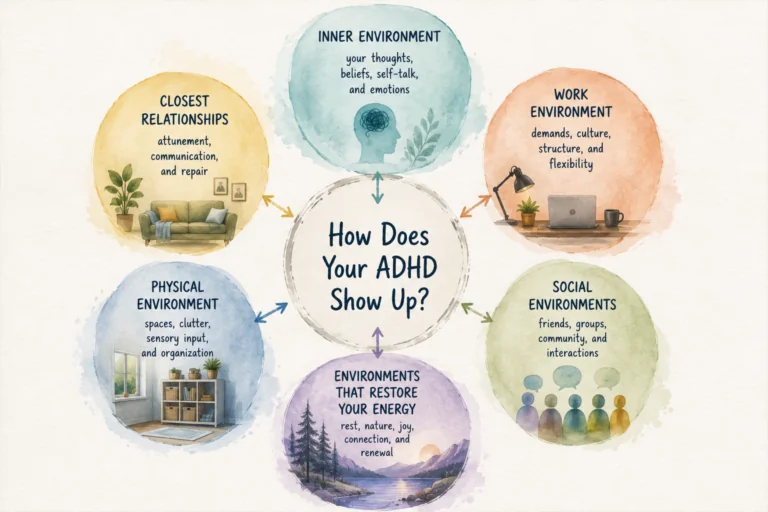
You know your environment affects your ADHD. Learn how these environments make it easier or harder to operate effectively.
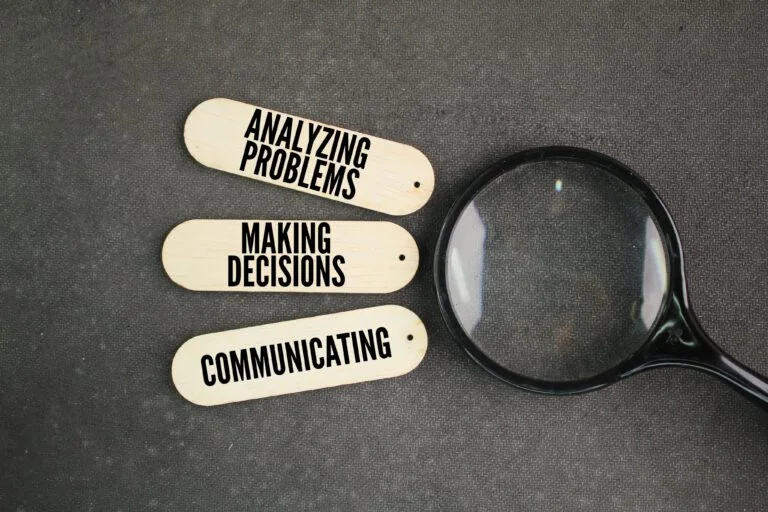
Learn how ADHD affects executive functioning, making everyday tasks feel harder. And steps you can take now to improve your skills.

Recently diagnosed with ADHD as an adult? Learn what to do next, including how to learn the skills, and find the support you need.

Discover how ADHD symptoms show up in high-functioning adults, and why success on the outside can mask daily struggles.

DESCRIPTION: Processing slowly whether it’s in conversation or reading is a common challenge for ADHD adults. While it’s not related to your intelligence, it could be related to your ADHD. Hear about the possible connections between processing speed and ADHD as well as the workarounds you can use to still reach your goals. KEY TAKEAWAYS: Processing speed is about accuracy and consistency, as well as the rate at which you process information. The rate at which you process information is not about your intelligence. There are strategies you can use to process information accurately and consistently, though perhaps not at the speed you’d like. TRANSCRIPT: 00:00: You’re reading or listening in a meeting or in a one-on-one conversation. Maybe you’re not following the thread of…

(originally published July 4, 2011, updated January 6, 2021) Many ADHD adults want a better memory. You, too? It’s definitely one of the challenges adults with ADHD find most infuriating. If you’re struggling with memory challenges you may find yourself at times saying some variation of the following: So, I don’t leave you in suspense I’ll share the punchline with you now. And that is, your ADHD brain is great for thinking and creating. But your brain wiring isn’t reliable for remembering something at the exact time and place you need the information. Sure, it may come to you, but maybe not when you need it. That’s because your memory really is much more like Swiss Cheese than a trapdoor. ? I know it’s annoying,…
(originally published August 8, 2014, updated October 9, 2020) I bet, like many ADHD adults, one of your superpowers may be your ability to think outside the box in many contexts. But, if you think your ADHD is a handicap, you may be falling short in doing this when it comes to managing your ADHD so you can create a life that works for you. In part, this may be because somewhere along the way you fell into the trap of comparing yourself to your neurotypical peers. As part of this comparison you decided you need to operate the way they do. And, when you discovered you couldn’t do this, you decided you’re handicapped. That’s just not true. You’re not handicapped. Sure, it may be…

(originally published May 13, 2011, updated August 7, 2020) We all want to minimize our challenges, of course. No doubt, our lives would just flow better if there were fewer boulders in the way. After all, you’re reading this article because that is what you want. Specifically, you want to minimize the detours you need to take because of your ADHD challenges. What if you could use your strengths to manage your ADHD? Though, like many who are trying to figure out how to manage their ADHD, you may assume you are broken. If this is your perspective, you might be focusing your time and energy on trying to fix yourself. Because that’s what you do when something is broken. You fix it, right? Here’s…