How Your Environment Affects Your ADHD Symptoms
Episode Summary:
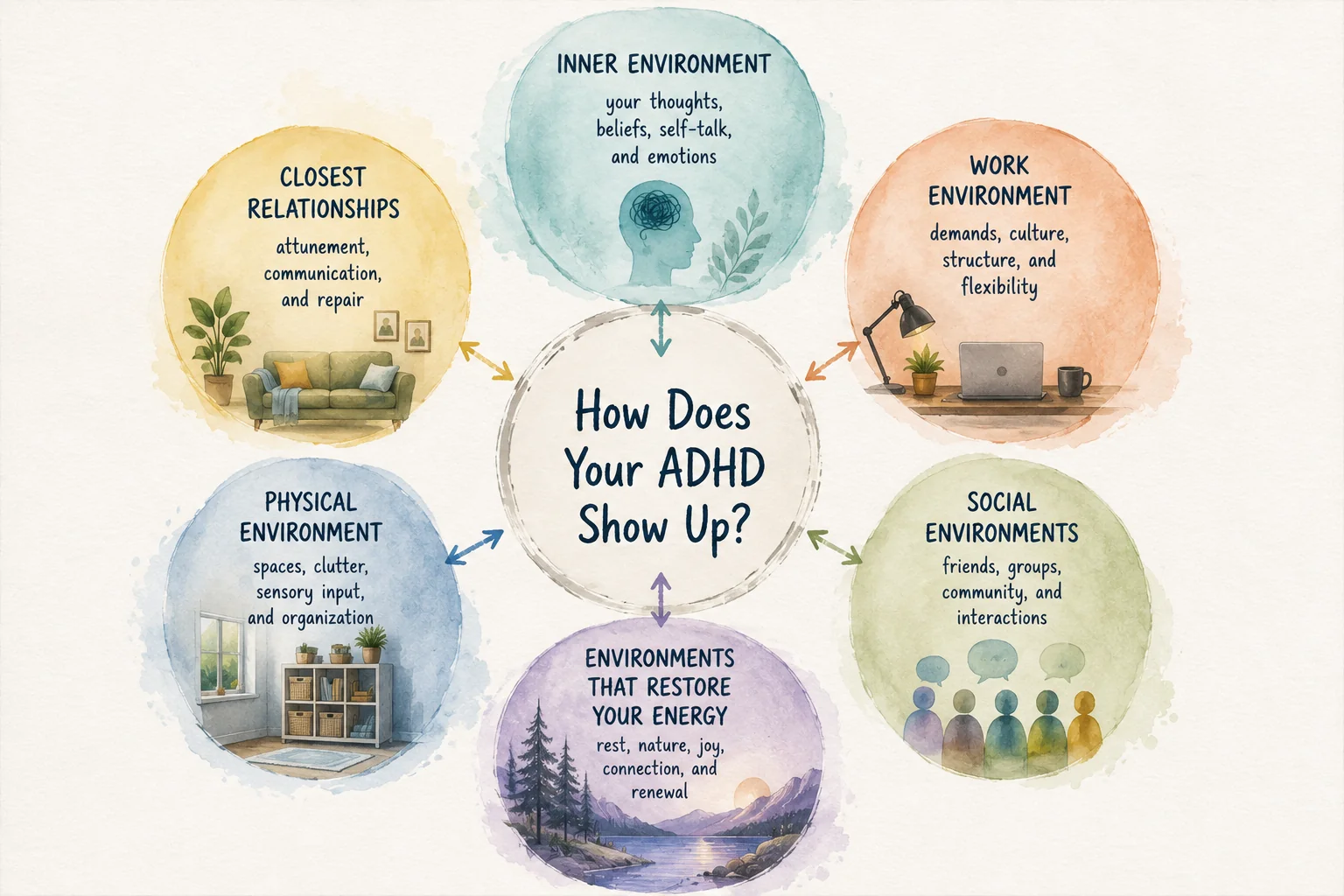
We often think about ADHD as something that exists within us, but the environments we operate in can influence how it shows up from day to day. In this episode, we take a closer look at the relationship between ADHD and the world around us, including the internal environment we bring with us wherever we go.
Rather than assuming that something is wrong with us when we’re struggling, we’ll explore what happens when we become curious about the context in which those struggles occur.
The goal isn’t to find a perfect environment or suggest that we can always change the circumstances we’re in. It’s to become more aware of what different environments are asking of us, how we experience them, and what might help us function more effectively as adults with ADHD.
What You’ll Learn About How Environments Affect Adult ADHD Symptoms:
- The beliefs and self-talk that can shape your inner environment and influence how your ADHD shows up
- Why attunement, communication, and repair matter in your closest relationships
- What to notice about stimulation, conversation, processing time, and belonging in different social settings
- Whether your physical surroundings are supporting what you’re trying to do or making it harder
- The workplace demands that can make it easier or harder to do your best work
- Why restorative environments matter and what happens when you give yourself space to slow down
Transcript:
(00:00):
Adults with ADHD often assume that if something isn’t working in their lives, the problem well must be them. If that’s true for you, you may not be stopping to ask yourself, “How is the environment I’m operating in contributing to my challenges?”
You’ve tuned into Reimagining Productivity with ADHD, a podcast for ADHD adults like you, who want to learn the best strategies, tools, and skills to get your essential work done in a way that works with the way your brain is wired.
I’m Marla Cummins, an ADHD and executive function coach. And I’m glad you decided to join me today on this journey toward doing what matters most to you without trying to do it like everyone else. Today, I’d like to introduce you to a different way of thinking about your ADHD. When things aren’t going well, as I said earlier, many of us instinctively look inward.
(01:01):
We ask ourselves, “What am I doing wrong? Why can’t I just get this right?” But we may rarely stop to consider the role our environment is inevitably playing in how well we operate. And when I say environment, I’m not talking just about your physical surroundings, though that is certainly part of it.
I’m also talking about your inner environment, the people around you, your work environment, social environments, and the environments that help restore your energy. To set the stage, I wanna be sure you know that I won’t be giving you a list of ways to change those environments or solve the problems you may have because of those environments.
Rather, in this podcast, I wanna help you take the first step, which is to become aware of them. Because once you begin noticing how different environments affect the way you think, feel, and function, you’ll have a much better understanding of why some situations seem to bring out the best in you, while others may leave you feeling overwhelmed or stuck.
(02:14):
And that awareness will better let you take the next step, which is to choose what to do if a particular environment is not serving you. In some situations, you may be able to change the environment. In others, you may decide to reduce your exposure or to remove yourself from it altogether when you realize that the environment isn’t something you can change, at least right now.
My hope is that you’ll begin to recognize that your struggles don’t occur in a vacuum. You’re part of many systems, and those systems influence how you experience and are able to manage your ADHD.
How Does Your Mindset Affect Your ADHD Symptoms?
(02:58):
The first environment I’d like to talk about is the one within you. For many adults with ADHD, their inner environment has been shaped over the years by the messages that we’ve received from others and then internalized such as, “You should try harder.
You don’t care. You only follow through when you want to. You’re such a slob. Why can’t you ever get anywhere on time? You made that mistake again? I’m sure you can think of plenty others. And over time, those messages can become the way you think about yourself.
Maybe you’ve come to see yourself as someone who disappoints people. Someone who forgets things. Someone who just can’t get organized or someone who just keeps on making mistakes. Now that’s the lens through which you experience everything else. For example, imagine you get an email from someone and the tone feels a little off to you.
(04:01):
If your inner environment is shaped by the belief that you disappoint people or that you’re always doing something wrong, you might immediately think, “Did I do something? Are they annoyed at me? Did I screw up? “Now, imagine that same email when you’re approaching the situation with more curiosity, calm and confidence.
You might think, “Hmm, that sounded a little off, a little different than usual. I wonder what’s going on. “You might even decide to check it out rather than filling in the blanks yourself. Same email, very different experience. Ultimately, your inner environment affects the way you move through the world.
While you certainly don’t have control over everything that happens to you, the way you think about yourself and respond to others can influence the choices you make and the interactions you have. So are the beliefs you’re carrying right now helping you move toward the life you want?
(05:07):
Or are they making that journey with ADHD more difficult? As we move through the rest of this episode and explore the environments around you, keep your inner environment in mind. Now let’s move from your inner environment to the environment that includes your closest relationships, because the people we’re closest to can either make it easier or harder to navigate life with ADHD.
I’m sure you’ve experienced this before. So let’s start by exploring three important aspects of those relationships. Attunement, communication, and repair work. There’s certainly a lot more that goes into relationships, but let’s look at these.
A good place to start is by exploring the question of attunement. The feeling that another person really gets you. That is they’re interested in understanding how you think, curious about your perspective, and accept you. Yes, even when you make mistakes or just operate in a different way than what they might choose.
How Do Your Close Relationships Affect Your ADHD Symptoms?
(06:15):
And of course, you just enjoy being around each other. That doesn’t mean they agree with everything you do or that they won’t hold you accountable for your actions. In fact, healthy relationships often include accountability.
But accountability feels very different when it’s built on understanding instead of judgment. So think about the people in your life. Who do you feel good being around and don’t feel you have to mask? Now, of course, attunement is only part of what makes a relationship.
The next area I want to explore is open and honest communication, which is often not attended to enough for adults with ADHD. And that makes sense to me because, well, it can be hard and maybe even feel risky at times.
Think about whether you can express your feelings or bring up concerns without worrying that you’ll be dismissed or told you’re just too sensitive. Many people with ADHD spend a lot of time trying to figure out what somebody else is thinking or replaying conversations in their heads.
(07:26):
You too? Sometimes we end up filling in the blanks instead of checking things out. For example, a friend and I had talked on and off over the past few months about figuring out how to get together since we live far apart. I suddenly started feeling that maybe she didn’t really want to come to see me or for me to come see her.
But instead of sitting with this, I decided to ask her about it. It turned out that I had completely misread the situation. At the end of the conversation, I told her that I was really glad I asked. It’s not the first time we’ve had these types of conversations and probably won’t be the last.
And this brings me to something that in my experience working with ADHD adults is another one of the most overlooked skills in relationships. And that is being able to do the repair work needed when things go wrong.
(08:22):
Because while things will go wrong, there will be misunderstandings, hurt feelings, frustration, and even anger when you forget something from time to time, interrupt someone on occasion, miss a deadline or something else. You get it.
That doesn’t mean you shouldn’t work on doing better. Of course you should. But lasting change is much more likely when you can do the repair work, whether that’s simply an apology or fixing a situation when possible, or maybe creating a plan together to minimize the chances of it happening again without fearing shame or rejection.
And by repair work, I mean talking about what happened, apologizing, and again, just figuring out how to move forward. Here’s a very small example that happened recently to me. Last week, my daughter and I were watching a TV series together. She had seen the show before, but I hadn’t. And she wanted to tell me something about one of the characters while we were watching.
(09:31):
I don’t know about you, but for me, trying to listen to a show while someone else is talking to me can be a little bit of sensory and cognitive overload. So instead of pausing the show and listening to her, which I wish I would have, I just said, shh.
I could see the look on her face and I knew something was wrong. I didn’t know exactly what it was, but I knew my response had not landed well. So the next day I just sent her a text and simply said I was sorry. And sure enough, she said she was irritated.
You know, it wasn’t a big deal, but it was an opportunity to acknowledge what had happened, take responsibility for my part, repair it, and then we moved on. Think about the important relationships in your life. Are you both willing and able to talk about what happens when things go wrong without you feeling shame or rejection?
(10:26):
Relationships don’t have to be perfect. Neither do the people in them. But relationships that make room for curiosity, accountability, repair and growth create an environment where it’s much easier to keep learning, making changes, and just becoming the person you want to be.
How Does Your Social Environment Affect Your ADHD Symptoms?
(10:49):
So we’ve moved from your inner environment to the people close to you. And now I’d like to explore your broader social environment and how it may affect how your ADHD shows up for you.
These might include volunteer organizations, professional associations, meetup groups, spiritual or religious communities, neighborhood events, or any other group where you regularly spend time with people.
Take a moment right now to think about the social environments you’re most often in. Got a few in mind? Now think about what happens for you in these different settings. For example, do you enjoy large groups or do you tend to gravitate towards smaller groups of maybe two or three people? Maybe your sweet spot is even one-on-one conversations.
(11:50):
One reason for that might have to do with processing. Are you comfortable with fast-paced conversations? Or do you need more time to take in what somebody has said? Think about it. Organize your thoughts and then respond the way you’d like.
I know that I’m much better in one-on-one conversations. In larger groups, I sometimes get lost or honestly kind of bored. Anyway, then there’s stimulation. Some adults with ADHD love loud, busy, high-energy environments.
Others find that much stimulation makes it harder to pay attention, follow conversations, or even know where to focus. Maybe you do better in a quieter setting, like a cafe with some ambient music. And then there’s the social experience itself.
Do you feel like you belong? Can you be yourself? Do you feel comfortable enough to participate or are you spending a lot of energy monitoring yourself, figuring out what you’re supposed to be doing or masking?
(13:00):
And notice that these things can interact. Maybe you love being around people, but large groups make it difficult to process conversations. Maybe you enjoy a loud, energetic environment, but find yourself exhausted afterward. Maybe you don’t have trouble with stimulation at all, but you feel you don’t quite fit in.
So rather than deciding that a particular social environment is good or bad for you, I just want to encourage you to become curious about what’s actually happening for you in those settings.
That is, what is it about this environment that affects how comfortable you feel, how well you can participate, and how much you just enjoy being there? It could be something about the environment itself or could be the way your ADHD shows up in that environment.
It could be your expectations, past experiences, the people you’re with, your energy level, or something entirely different. More often than not, it’s probably a combination of all those factors.
(14:11):
The goal isn’t to decide that you should avoid certain social environments or force yourself to become comfortable in them. It’s simply to understand yourself a little better in this environment.
Because the more curious you become about what’s affecting your experience, the less likely you are to jump to conclusions about yourself or the environment. I know when you think about environments, you may think about your physical environments.
And as I said before, that certainly can impact how your ADHD shows up. So let’s get into it. Take a moment to look around the space you’re in right now. What do you notice? More importantly, what do you feel? Do you feel calm, comfortable, able to focus?
As you’re looking around, ask yourself, “Is this environment supporting what I’m trying to do right now or making it harder?” If you’re trying to focus, does this space help me concentrate?
How Does Your Physical Environment Affect Your ADHD Symptoms?
(15:21):
If you’re trying to relax, does it help me unwind? Or do you notice a low level of stress because there are piles of things around you? Maybe your eyes keep landing on unfinished projects or perhaps you’re wondering, what am I forgetting? Simply because there are so many visual reminders competing for your attention. Now notice the lighting. Is there enough? Is it too bright? Too dim? Is it appropriate for what you’re trying to do?
(15:54):
Next, think about the noise level. Some adults with ADHD concentrate better with a little background noise. Others find almost any noise distracting. Neither of course is right or wrong. The important question is whether the level of noise is helping or hindering what you’re trying to do.
And if you work outside your home, think about that environment too. Do you work in an open office? Is there constant movement, conversation or interruptions? If so, how does it affect you? Or perhaps you have a private office where it’s easier to control distractions.
Finally, think about your workspace. Is it set up in a way that supports the work you’re doing? Is your chair comfortable? Is your desk arranged in a way that helps you work effectively? Do you have enough room to move if movement helps you think more clearly?
So as you think about your physical environment, don’t worry yet about what you can or can’t change.
(16:56):
Just notice how it impacts you and how it may affect how your ADHD shows up for you.
How Does Your Physical Environment Affect Your ADHD Symptoms?
(17:05):
And since many of us spend eight or more hours a day at work, whether onsite or remotely, it’s of course worth taking some time to consider your work environment. Since we’ve already looked at your physical environment, I won’t revisit that aspect here, although of course the physical space where you work still matters.
Instead, I wanna talk with you more broadly about your work environment. To start, consider whether the work you do primarily draws on your strengths or whether it regularly requires you to operate in areas that are comparatively more difficult for you, perhaps at least in part because of your ADHD.
(17:50):
And when your work does require you to use skills that are more challenging for you, are the resources, support and flexibility you need to do the work effectively available? And also let’s talk about the pace of your work. Does the pace match the way you naturally work?
Or do you constantly feel like you’re trying to keep up? Or maybe you, are you bored? Some adults with ADHD thrive in fast-paced environments. Others do their best work when they have more time to think, plan, and complete one task before moving on to the next.
The important question is whether the pace of your work supports you or leaves you feeling like you’re always behind. And what about task switching? Are you able to stay with one task long enough to make meaningful progress? Or are you constantly interrupted by emails, messages, meetings, or requests that require you to change directions?
(19:01):
Many adults with ADHD find that frequent task switching requires a tremendous amount of mental effort because every switch means reorienting themselves to a new task. For example, earlier in my career, as I’ve mentioned before, I was a teacher.
And I really did enjoy many aspects of teaching. But because of the pace and number of transitions throughout the day, I just wasn’t able to do my best work. I had to constantly shift gears and respond to what was happening in the moment, which as you know, is pretty much what young people require.
And this wasn’t something that could change. Anyway, next, think about how clear the priorities and expectations are. Do you generally know what’s most important? Or are priorities constantly changing, leaving you to figure out what deserves your attention first?
Many adults with ADHD actually do better when expectations are clear and consistent. When they’re not, it’s easy to spend a great deal of mental energy just deciding what to work on.
(20:14):
Then of course there’s the workload. So is the amount of work you’re expected to do realistic given the time you have and the pace at which you operate the best? Or do you constantly feel like the demands just simply exceed your capacity?
Believe me, I spent many weekends surrounded by tons of paper I needed to grade. I don’t relish those memories. And finally, just as communication is important in your close relationships, think about your workplace communication.
If priorities change or something isn’t clear, do you feel comfortable asking for clarification? Can you negotiate deadlines or priorities when needed? Or are you just left guessing what others expect of you?
How Does Your Restorative Environment Affect Your ADHD Symptoms?
(21:09):
As you reflect on your work environment and what it’s asking of you, I just would like you to take note of whether those demands make it easier or harder for you to function as an adult with ADHD.
Throughout this episode so far, we’ve been talking about environments that place different demands on you as an adult with ADHD. Your work environment asks things of you. Your relationship asks things of you. Your social environment asks things of you.
Even your physical environment can place demands on your attention and focus. Now I’d like to switch gears and ask you to think about a different kind of environment. And that is environments that restore your capacity to go about your day-to-day life in the way you want.
For many adults with ADHD, so much of the day, like actually for many people is spent doing. Working, commuting, cleaning, preparing meals, taking care of children, parents, pets, clients, you get it.
(22:22):
Even many of the things we enjoy still take up quite a bit of our energy. Maybe that restorative time for you is a walk in nature. Having your morning coffee out on your porch, listening to music, or just watching the birds in your backyard.
Now I know for some of you, this might be a hard sell because you may be thinking, “That sounds nice, Marla. I’d like to sit out in my backyard looking at birds too. But I have a lot of stuff to do. And I’ll take my coffee to go. Thank you very much.”
But before you decide this doesn’t apply to you, take a minute to just hear me out. What happens for you when the demands ease up for a little while? When you don’t have to keep producing, solving problems, making decisions, organizing, remembering, or thinking about what comes next? It’s like a calm oasis.
(23:28):
Sometimes if being productive is your thing, you may assume that if you’re not accomplishing something and nothing important is happening, then you should get going. You should get on the ball and start working.
But I don’t think that’s necessarily true. Think of a chrysalis from the outside. It appears completely still. Yet we know inside, remarkable change is taking place. So I’m thinking that perhaps stillness for us serves a similar purpose. Maybe moments of calm help us engage in our day-to-day life with a little bit more ease.
(24:15):
On the one hand, one of my favorite environments is early in the morning with a cup of coffee, a good book, some quiet music, and the sun just beginning to come up. Yep, I’m an early riser. I’m awake. I’m reading. I’m thinking. But there’s a completely different quality to that experience.
My mind just feels more spacious. My nervous system is calm. I don’t feel hurried usually. It doesn’t always work this way, but many mornings it does. So what environments help restore your capacity to engage with the rest of your life?
What I hope you’re taking away from this episode is that while your ADHD symptoms aren’t gonna disappear, the environments you operate in can make it easier or harder for your ADHD to show up in ways that support the life you want.
That’s it for now, and I’m really glad you joined me. If this resonated with you and you wanna hear more strategies for working with your ADHD or executive function challenges, please hit like and follow so you don’t miss future episodes.
(25:32):
And until next time, this has been Reimagining Productivity with ADHD. I’m Marla Cummins reminding you that ADHD doesn’t define you, but how you work with it can shape what’s possible.
Your environment can make it easier or harder for your ADHD symptoms to show up in ways that affect how you think, feel, and function. Your mindset, relationships, social and physical environments, work environment, and the environments where you restore your energy can all influence how your ADHD shows up. Becoming more aware of how different environments affect you can help you understand what supports you and what makes it harder to function the way you want.
Resources To Help ADHD Adults Know Which Environments Are Helpful
- Learn how to plan better with my Free Guide: 6 Common Planning Mistakes Adults with ADHD Make.
- Join other adults with ADHD and Marla in this virtual live adult ADHD education and support group.
- Listen to this episode, Why ADHD Adults Struggle at Work (It’s Not What You Think), to learn more about how your work environment can affect your ability be successful in your job.
- Learn what mindsets can help ADHD adults be successful in this post, ADHD Adults Need These 5 Mindsets to Be Successful.